
Sonnenregister
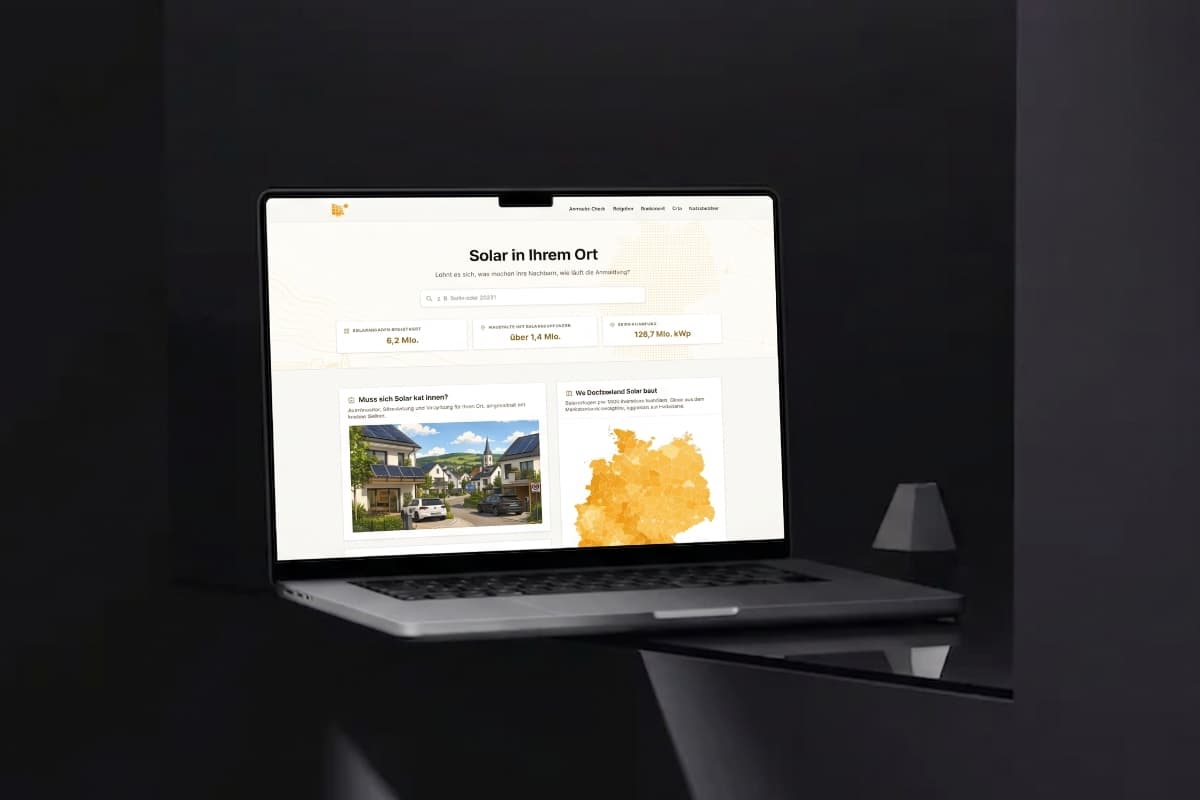
A consumer layer over Germany's national solar register. It turns Behördendeutsch and 6 million raw MaStR records into local numbers people can act on: how much solar is already registered in their postcode, and whether it pays.
- Gemeinden covered
- 11,048
- Solar units mapped
- 6.2M
- Data refresh
- Monthly
Problem
Germany's energy transition runs on millions of individual decisions, and the data meant to inform them is written for regulators.
The Marktstammdatenregister holds every solar installation in the country. It is public and complete, but it ships as a bulk export built for grid operators and GIS analysts.
That leaves the people making the decision with two poor sources: official guidance written in Behördendeutsch, and installer marketing with a quote attached. Nothing sat in between.
Approach
The register was rebuilt as a consumer product. A monthly pipeline pulls the full MaStR export, normalises it against Destatis population and DWD irradiance data, and resolves it to every Gemeinde and Kreis in the country.
An interpretive layer sits on top. Local install counts, capacity and growth become plain-German readings of what is happening in a specific place, so 1.41 million Balkonkraftwerke and 2.59 million storage units get read back at the scale someone recognises as their own.
Two rules shaped the build. Data is used as reassurance rather than pressure, so late registrants are welcomed instead of lectured. And the product keeps an honest boundary: MaStR does not publish street-level detail for small residential units, so it promises the postcode and stops there.
Compliance guidance, local data and economics are kept structurally separate, which keeps advice clear of any sales pitch.
Outcome
A calm, fast, German-language layer over national open data. Static-first, cheap to run, covering every Gemeinde in the country.
It answers what neither the regulator nor the installer will: what is already happening where you live, and what it means for you.